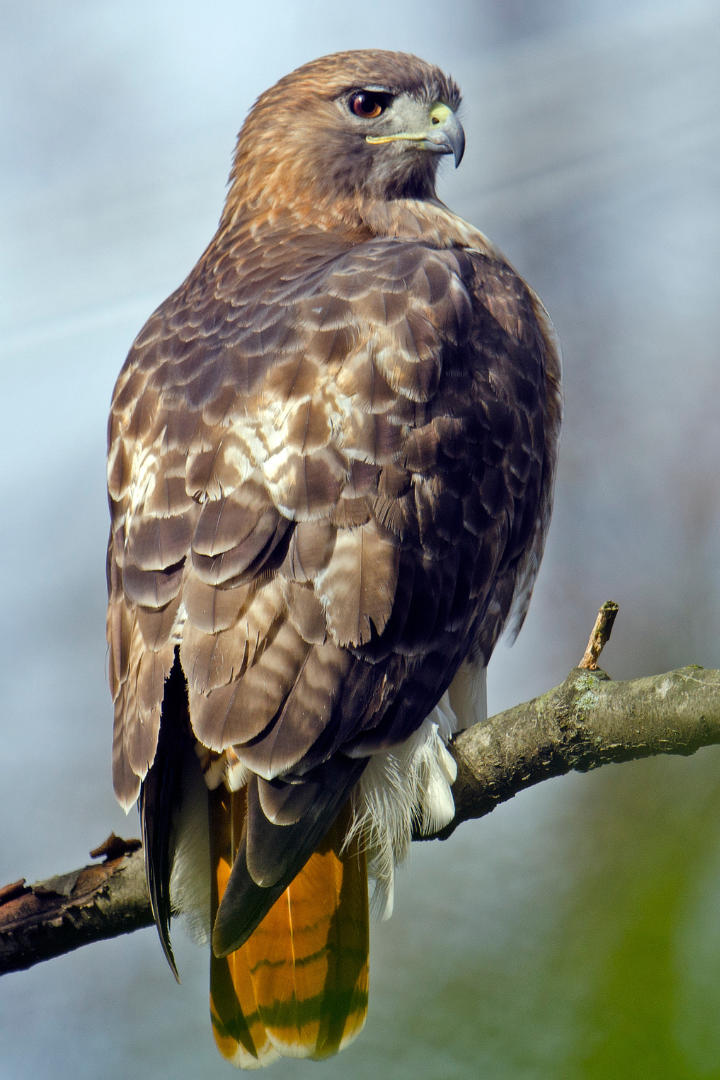
Specialized vision allows raptors to detect tiny details, see in more colors, and judge distances with impeccable precision
Long before humans developed binoculars, telescopes, or drones, raptors evolved visual systems so powerful that they can spot a mouse from hundreds of feet in the air. Their vision is not just better than ours; it is fundamentally different and shaped by millions of years of hunting from the sky.
One of the most striking features of raptor vision is sharpness of sight. A hawk soaring high above a field can detect the subtle movement of a vole hidden among grass that looks completely still to us. Raptors have large eyes relative to their head size, packed with a high number of light-detecting cells, creating an image that is both crisp and precise. Raptors also have one or even two specialized areas in the retina called foveae, which act like built-in zoom lenses, allowing them to focus intensely on distant targets.

Color vision is another strength for many species. Unlike humans, who have three types of color-sensing cells, many raptors have four, allowing them to see a broader range of colors. Some species can even detect ultraviolet light, which is invisible to us. This ability can reveal urine trails left by small mammals or subtle feather markings on other birds, all useful clues when hunting for prey.
Depth perception is equally important. Like humans, raptors rely on forward-facing eyes, giving them excellent binocular vision, which is critical when diving at high speed or grasping prey with talons. A falcon hurtling toward its target must calculate distance, speed, and angle in a fraction of a second.
Not all raptors see the world in the same way. Owls, masters of low-light vision, have extremely sensitive eyes, allowing them to hunt at dusk or in near darkness. While owls trade some sharpness and color vision for light sensitivity, they compensate with incredible hearing, forming a powerful nighttime hunting toolkit.
Raptor vision is more than a biological marvel; it plays a vital role in ecosystems. By efficiently locating prey, raptors help regulate populations of rodents and other animals, contributing to ecological balance. Raptor vision is a stunning example of nature’s engineering: Eyes designed to read the movement, color, distance, and detail of the world all at once, from the sky.